
Over My Dead Body
For years I knew exactly how I wanted my coffee. My death preferences? Not so much. I had strong opinions about almond milk. But not ventilators. I finally fixed that. Here's how & why you should too.

I’ve spent the past few years talking about death…a lot!
Not in a creepy way.
I mean, professionally.
I wrote a book about why mortality awareness isn’t morbid… it’s motivating. It’s called: Your To-Die For Life. (If you’re curious, click here.)
You’d think that because I’m talking about death all the time, I’d be depressed.
Or at the very least, the person nobody wants to sit next to at brunch.
But oddly enough, it’s made me happier. More present. Bolder.
It’s also made me, surprisingly, very popular at brunch.
Once people realize I’m not goth or morbid (just passionately philosophical about death), they lean in, fork midair, and tell me their death fears and wishes, in whispered voices, as if the Grim Reaper himself might be eavesdropping.
"I don’t want to die alone."
"I don’t want to die during a colonoscopy."
“I want to die quickly. Like mid-laugh. Or of a heart attack in the garden.”
"I want to die peacefully in my sleep."
“I don’t want to be in too much pain.”
“I want some sense of dignity.” (That’s a word I hear a lot.)
Apparently, these are the winning answers in the Great Game Show of Death Preferences.
I’ve also heard lots of wishes for where people want to pass.
Some prefer to be in a hospital or hospice.
They don’t want to be a burden. They don’t want someone they know to have to clean them. Even if that someone loves them. Even if they’d gladly do it.
Others want to be at home.
No beeping monitors. No hospital gowns with the tie in the back and your butt out. No nurse who calls them “sweetie.” They simply want to be surrounded by the people they love. (Or at least like.) And preferably with their dogs or cats nearby.
I’ve thought about my own version of a “Good Death.”
In many ways, my father had one.
He died in a hospital room, surrounded by family. We told him stories. Whispered I love yous. I held his hand tightly in mine as if that might somehow stop time.
He had some dementia at the end. He forgot how to drive home from the supermarket. He didn’t remember a recent trip to China with my mom.
But he still remembered us. And that meant everything. Because we could still say goodbye. And he could feel the cushion of love and softness around him at the end of his life.
My death preferences?
I want to be at home. With my chipped coffee mug. The squeaky door hinge. The artwork made by my friends.
I want my loved ones nearby. The ones who won’t flinch if I say something strange. The ones who will not only shed tears…but tell inappropriate jokes to lighten the mood.
And I want to be clear of mind.
I want to be able to say what needs to be said. Share a few poignant memories. Forgive who needs forgiving. Tell someone a secret. Give away my favorite chipped mug with a funny story attached.
And so I pray that I go… before I’m entirely gone.
Before the “me” of me evaporates.
I worry about this last bit a lot.
In fact, I think I fear dementia… even more than death itself.
I’ve witnessed what dementia did to my dad, and it was… scary.
But death, at least, has the courtesy to be a one-time event. Bam. Done.
Dementia? It’s death by a thousand paper cuts.
The body stays. The calendar flips. People visit. You forget their names. Then you forget they came. Then you forget what visiting means.
Soon there are blank spaces where memories should be. The sound of someone saying “Mom?” like it’s a test.
Some people think: “At least the person is still here.”
But I don’t want to be still here… if I’m not still me.
In many ways being a writer is being a rememberer.
I’ve spent my life collecting moments. Turning them into stories. Meaning. Books. Jokes that carry truth. And truth that sneaks in like a joke.
I’m a gatherer of life’s absurdities and aches.
I relish access to my mind so I can do what I do: make sense of chaos, comfort with clarity, connect with others.
Dementia threatens that. Not just my independence or my timeline…. but my voice.
If I lose that, then I lose me.
And that’s not just scary to me. That’s a kind of grief I don’t want my loved ones to witness.
I recognize I do not get to decide how death shows up.
Death does not take requests.
It doesn’t text to say “on my way.”
It doesn’t care if you’re mid-sentence or mid-shampoo.
So I wrote down my “Good Death” Preferences.
I confess I put this off for a while.
Most people do.
It’s strange when you think about it.
People plan weddings with binders.
They plan vacations with spreadsheets.
They send back a latte if the milk is wrong.
But their final exit out of this world?
They often give this a vague shrug.
I believe it’s very important we think about how we want our final chapter to unfold.
Yeah. I know. Death is a bit of a mood shift. It’s scary to think about.
But when your time comes, you don’t want your loved ones guessing your last wishes. Or arguing over them. Or carrying the weight of not knowing what you would’ve wanted.
Writing it all down is one last way to say: I love you.
And it’s easier to do than you might think.
It all starts with a talk.
One night, instead of watching a movie, my partner Howard and I talked about our death preferences.
The next week, we each created end-of-life documents.
The week after that, we went to a lawyer.
My document states:
The if-I’m-not-fully-mentally-here-do-not-keep-me-here requests.
The please-don’t-turn-me-into-a-science-project-just-because-some-machine-can-still-find-a-pulse clauses.
The no-heroic-measures-if-I’m-already-halfway-to-the-stars clauses.
The please play that one Regina Spektor song that makes everyone cry in a good way request.
The desire to be cremated then scattered in the ocean. Or housed in a beautiful urn that hopefully complements the artwork in my son’s living room, because yes, even in death, I care about design.
Sure, it felt a little sad to write it down.
But it also felt kind. Because now the people I love won’t have to carry that extra burden while they’re already grieving.
Plus, there’s a surprise bonus benefit.
I know this might sound strange… but… the more you talk about death, the more alive you will feel.
Because when you face the truth that you’re here… then you’re not… you start doing everything you can to make the here part count.
Mortality awareness snaps you out of the hypnotic blur of errands and inboxes and “later.”
It burns through your excuses and leaves you face-to-face with your limited-one-time-only life.
You stop trying to be impressive. And start wanting to be real.
You stop waiting for someday. And start living with more urgency.
You say the thing.
You forgive the person.
You eat the peach.
You schedule the vacation.
You buy the ridiculous shoes.
You call your sister.
You stop scrolling through everyone else’s life. You show up for your own.
Because when you really “get” that this whole weird human experiment is temporary, you understand that the point of life isn’t to live forever.
It’s to live vividly.
In many ways, the enemy of life is not death.
The enemy of life is forgetting you’re alive.
You can’t control how your life ends.
But you can choose how much of you shows up in the middle.
So when you finish reading this essay, don’t just ask yourself:
"How do I want to die?"
Ask yourself:
"How awake and alive do I want to be while I’m still here?"
And then go do one small brave thing.
Right now. While you still can.
This essay is your gentle reminder to live BOLDLY while you’re still here!
However… this idea isn’t just a one-off essay.
It’s a full philosophy I believe in so deeply, I wrote an entire book about it:
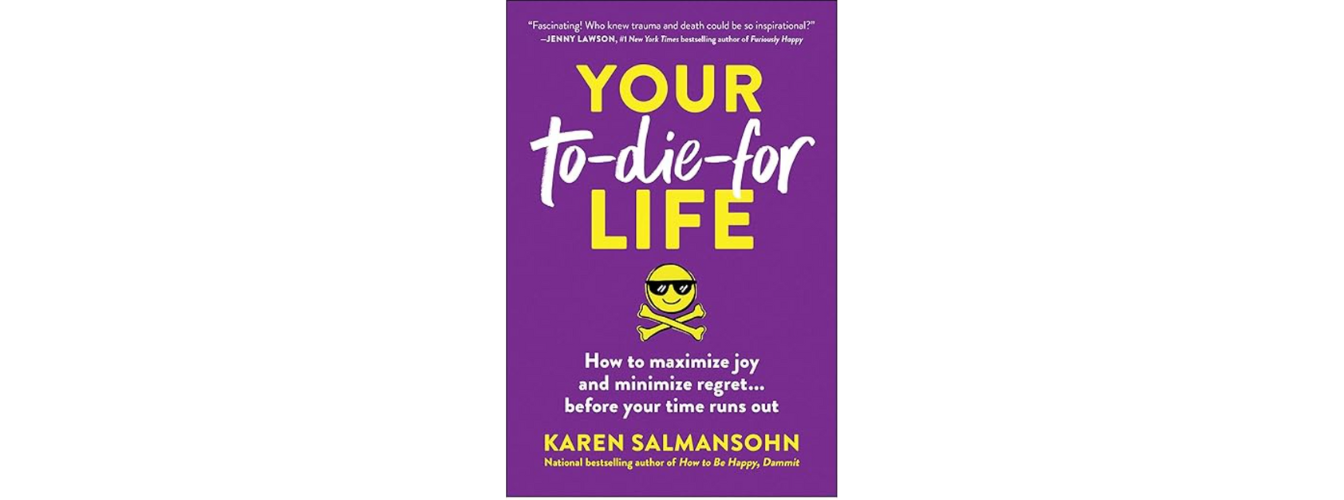
If you’re ready to live more vividly, love more boldly, and stop postponing things that matter…. my book might just become your new favorite book!
Because your life is still unfolding.
And there’s still time to make it one you’re truly proud of!

Share below! Tell me your idea of a “good death.”
Or tell me some bold things you’ve done or plan to do!
This was like a warm hug from the Grim Reaper whispering, “Don’t waste your damn life.”
You managed to wrap up death, dementia, lattes, legal docs, and Regina Spektor into a single, soul-affirming mic drop—and now I suddenly feel like updating my will and calling my sister.
Thank you for turning the existential horror show into a design-conscious act of love. You made death planning feel less like a cold checklist and more like a final love letter—written in your own font.
Off to eat the peach and schedule the trip. And maybe buy the shoes too.
I found this particularly relevant and timely as my father is in the process of leaving this world, my children are leaving the house and I'm not getting any younger at 57. I am more accepting of time marching on at this point. Thanks for writing this.